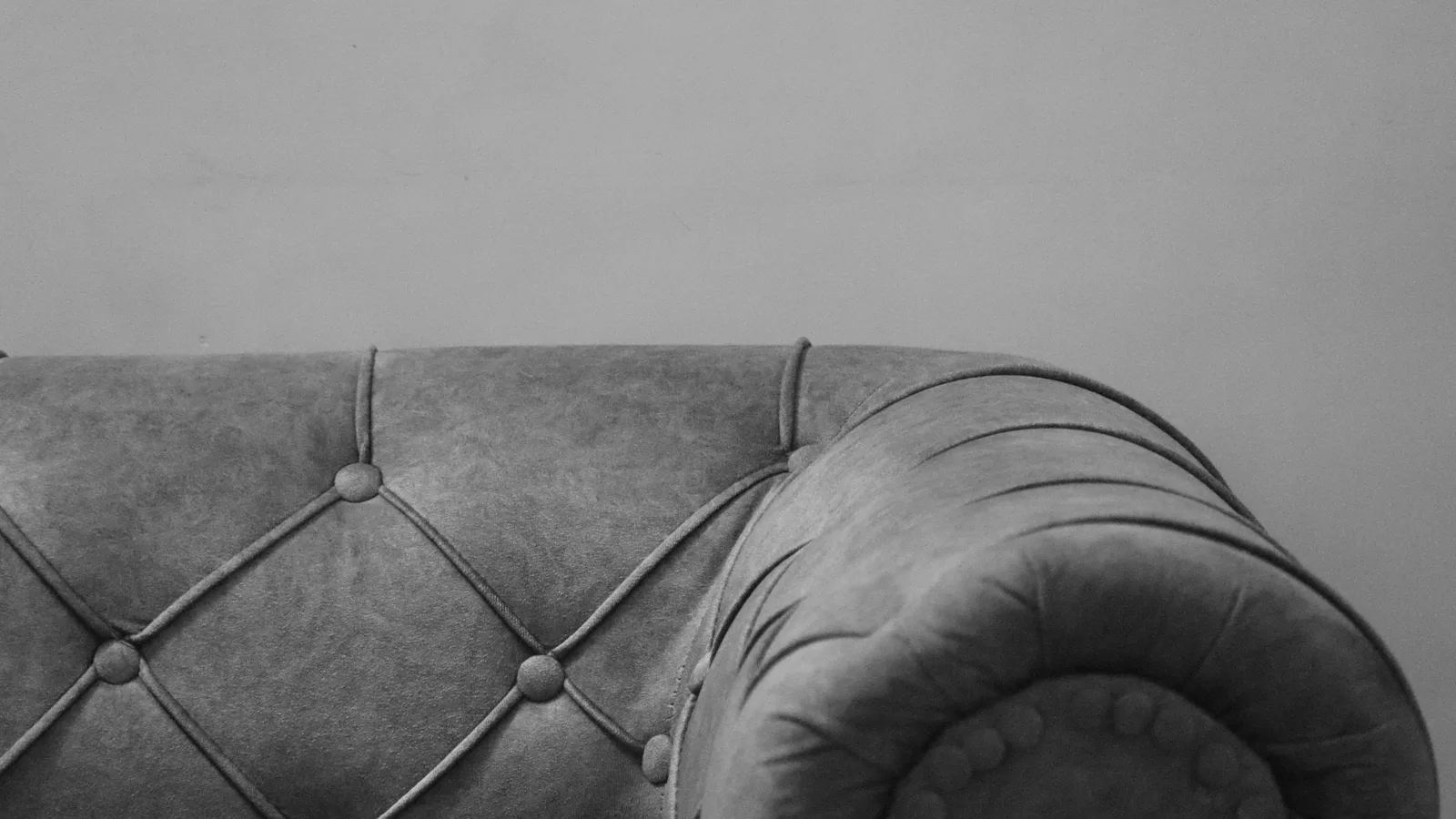
Somewhere on your sofa — usually on a tag under a seat cushion or stapled to the underside of the frame — there is a single letter that decides how it can be cleaned. W means water-based cleaning is safe. S means solvent only, and water will mark it. WS means either. X means neither: vacuum only, and any liquid at all risks a permanent ring. That letter is the first thing we look for, and it is the thing most people cleaning their own sofa have never seen.
Velvet is the fabric that punishes mistakes fastest. It's a cut pile, which means thousands of short fibre ends standing upright, and the way it catches light is entirely down to which direction they're lying. Get it too wet and the pile mats into a crushed patch that catches light differently from everything around it — and that patch is visible from across the room, permanently. Velvet takes low moisture, careful grooming to reset the pile direction afterwards, and no pressure at all from the tool.
Microfibre is the opposite problem. It cleans beautifully and it forgives almost any chemistry, but it shows a water edge like nothing else. Clean half a cushion and stop, and you get a hard tide line exactly where you stopped. So microfibre has to be worked panel by panel to a natural seam, every time, even when only one corner is dirty. That is also why a spot-clean on microfibre so often looks worse than the spot did.
Chenille and bouclé are loop piles, and the loops are very good at holding soil deep down where a vacuum can't reach. They need more dwell time on the pre-treatment and more passes with the extraction tool than a flat weave — but they're tough, and they come back well. What they don't tolerate is an aggressive brush, which pulls loops out of the weave and leaves a fuzzed patch.
Linen and cotton shrink. They're natural fibres, they're often loose-woven, and putting them in too wet means the cushion cover comes back a size smaller than the cushion. These take a low-moisture method and a hard dry.
Leather isn't cleaned at all in the sense the rest of this list is. It's a skin, it's finished with a coating, and hot-water extraction strips that coating and dries the hide out. Leather is cleaned by hand with a pH-appropriate cleaner and then conditioned to put back the oils the cleaning took out.
Performance fabrics deserve one honest note. They genuinely do resist a spill — a drink beads and sits on the surface long enough to blot. What they don't resist is the slow grey build-up of body oil and dust along the seat edge and the headrests, because that isn't a spill. And the finish wears off fastest exactly where people sit. A performance fabric still needs cleaning on the same schedule as any other; it just gives you a better chance with the occasional accident.
If you can't find your tag or can't read it, send us a photo of the piece and a close-up of the weave at (773) 512-2629 and we'll tell you what it is and what it takes.